
Finding the right boat dock in Australia used to be a fairly simple decision. These days, waterfront owners want a lot more than just somewhere to tie up. They’re after durability, flexibility, low upkeep, and a system that can grow alongside their boating needs.
The trouble is, a lot of buyers focus purely on the upfront price tag and miss the factors that actually shape performance and cost down the line.
Common mistakes when choosing a floating dock:
- Choosing a dock that can’t be expanded as vessel requirements change.
- Selecting materials that require continuous maintenance in harsh Australian conditions.
- Misjudging the load capacity needed for boats, jet skis and waterfront activities.
- Putting in place a system that is hard to manage when water levels change.
- Ignoring the long-term convenience, accessibility and scope for future upgrades.
Recreational boating, marina developments and waterfront living are all on the rise across Australia, and modular dock systems in Australia have become one of the go-to solutions for residential and commercial sites alike. At Modular Docking we help Australian property owners and boating operators with practical floating docking solutions for a private jetty, marina or commercial waterfront operation.
Picking the right dock for 2026 comes down to vessel size, water conditions, access needs, future plans, and how much maintenance you’re willing to take on. Experts like Modular Docking look at stability, load capacity, drive-on access, material durability, and how well a system holds up to Australian waterfront conditions. A modular boat dock in Australia tends to be the preferred choice precisely because it can be expanded, reconfigured, and adapted for boats, jet skis, marinas, and commercial use as needs change.
What Makes A Floating Dock One Of The Best Options In 2026?
Bigger or expensive is not always better. What really counts is whether the dock works reliably in the conditions it will be exposed to day to day.
A solid floating dock should provide you with the following:
- Safe and no-slip walking surfaces.
- Room to expand or reconfigure later on.
- Secure access for boarding, loading and everyday use.
- Ease of launching and retrieval and requires little maintenance.
- Durable, corrosion-resistant materials that are designed for the conditions.
- The right amount of flotation for the vessel and the load that is expected.
- The ability to deal with changing water levels without any problem.
This is exactly where modular systems have carved out their popularity. Fixed structures are built around one layout and tend to stay that way, while modular setups can be adjusted as the vessel, the usage pattern, or the site itself changes over time.
On a private waterfront property, that might mean bolting on a jet ski dock a year or two later. At a marina, it could mean reworking traffic flow or adding extra berths. For commercial operators, it often comes down to adapting the layout for seasonal demand, events, or new types of watercraft coming through.
Design A Floating Dock That Grows With Your Needs
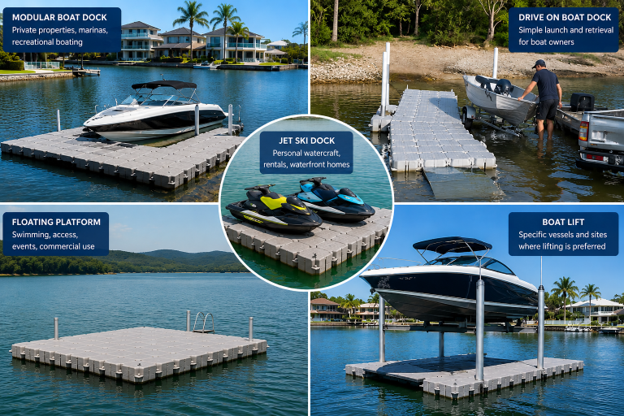
Which Floating Dock Type Suits Different Australian Applications?
No two sites need the same setup. Before locking in a boat dock in Australia, it pays to match the system to how it’ll actually be used.
| Dock Type | Best Suited For | Key Advantage |
|---|---|---|
| Modular boat dock | Private properties, marinas, recreational boating | Flexible layout and future expansion |
| Drive on boat dock | Owners who want simple launch and retrieval | Keeps vessels easier to access and maintain |
| Jet ski dock | Personal watercraft, rentals, waterfront homes | Stable storage and quick launching |
| Floating platform | Swimming, access, events, commercial use | Multi-purpose surface area |
| Boat lift | Specific vessels and sites where lifting is preferred | Keeps the vessel elevated when not in use |
A modular boat dock in Australia is generally the stronger pick when flexibility is the priority. That covers homeowners who might add a second vessel later, marina operators juggling multiple users, or commercial sites that need a genuinely practical access solution.
Above everything else, dock selection should follow the site, not the other way around. Water depth, tidal movement, exposure, vessel weight, access angle, and how often it’ll get used all play into what configuration actually works.
How Important Is Drive-On Technology For Modern Boat Owners?
Drive-on boat docks in Australia have caught on because, frankly, they make everyday boating a lot less hassle.
These setups let many vessels sit out of the water when they’re not in use, which helps cut down on prolonged hull exposure and removes a fair amount of the inconvenience tied to traditional mooring or lifting.
For owners who get out on the water often, that convenience tends to be the deciding factor. Drive-on setups can make launching and retrieval noticeably faster than systems that rely on more manual handling.
That said, drive-on systems still need to suit the vessel they’re paired with. Boat size, hull shape, water depth, dock angle, and site exposure all factor in, which is why a proper assessment before installation really does matter. What works beautifully for a small recreational boat might fall short for a heavier commercial craft or a high-wash site.
Are Floating Docks Suitable For Jet Skis And Personal Watercraft?
Yes, and a dedicated jet ski dock in Australia is often one of the most practical setups going for personal watercraft owners.
Jet skis get launched, retrieved, and stored constantly between rides, so easy access really counts here. A floating jet ski dock gives you a stable platform that keeps the craft within reach and cuts down on how often you’re hauling the trailer out.
Modern modular systems can typically handle the following:
- Single jet ski storage.
- Multiple personal watercraft at once.
- Residential waterfront access.
- Rental or tourism operations.
- Combined boat and jet ski layouts.
For homeowners, that translates to far easier weekend use. For commercial operators, it tends to mean better organisation, smoother access, and improved customer flow.
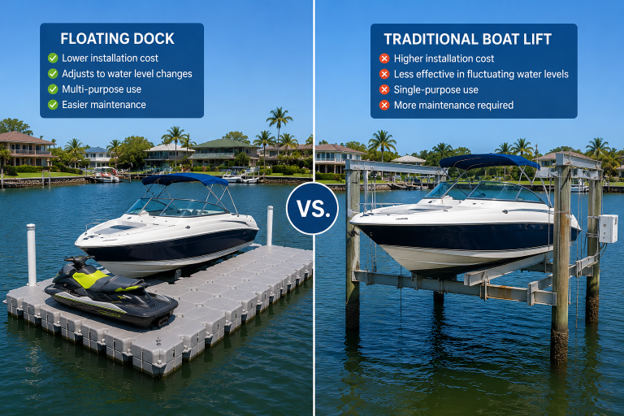
How Do Floating Docks Compare With Traditional Boat Lifts?
Both floating docks and boat lifts have their place, but they’re really solving two different problems.
A boat lift in Australia can work well where a vessel needs to be raised clear of the water and the site is built to support it. Lifts suit certain fixed waterfront setups nicely, though they often come with more site-specific requirements to work through first.
Floating docks, particularly modular ones, tend to win out on flexibility. They’re usually easier to adapt, expand, or reposition depending on the system and the conditions at the site.
Worth weighing up before deciding:
- Vessel size and weight.
- Water depth.
- Tidal range or changing water levels.
- Exposure to wind, waves, or wash.
- Frequency of use.
- Installation requirements.
- Long-term expansion plans.
- Maintenance expectations.
For most Australian waterfront owners, it’s not really a case of floating dock versus boat lift as a blanket rule. It comes down to which system actually fits the site, the vessel, and how the dock gets used day to day.
Why Are Modular Dock Systems Becoming More Popular?
Modular dock systemsin Australia have grown in popularity largely because they hand owners more control in the long run.
A fixed dock does the job, but it’s usually built around one specific layout from day one. A modular system, on the other hand, can often be expanded, reshaped, or upgraded without tearing out the whole structure.
That flexibility tends to matter when:
- A property owner upgrades to a larger vessel.
- A marina needs more flexible berth arrangements.
- A commercial site needs temporary or seasonal access.
- A waterfront home adds swimming or recreational space.
- Jet ski storage gets added after the original install.
For a lot of buyers, that adaptability ends up being the whole reason they go modular in the first place. It significantly lowers the risk of outgrowing the dock too quickly.
What Should You Check Before Choosing a Floating Dock?
Before settling on the best floating dock for your site, run through these practical points:
- Vessel type, weight, and hull shape.
- Number of watercraft being stored or accessed.
- Water depth at both low and high levels.
- Tidal movement or seasonal water changes.
- Wind, wave, and wash exposure.
- Access from shore, pontoon, seawall, or marina.
- Whether drive-on access is actually needed.
- Future expansion plans.
- Local approval or permit requirements.
- Maintenance expectations.
This step matters more than people expect, since two docks that look nearly identical can perform very differently once they’re actually installed. The best boat dock in Australia is the one suited to the real conditions of your site, not just what looks good in the product brochure.
Plan Your Waterfront Project With Trusted Dock Specialists
Conclusion
The best floating dock in Australia for 2026 strikes a balance between stability, durability, access, maintenance, and long-term flexibility. For most buyers, modular systems offer the strongest value over time, since they can be adapted for boats, jet skis, marina use, recreational access, and commercial waterfront needs alike.
Drive-on systems add real convenience for frequent users, while dedicated jet ski docks make storage and launching simple for personal watercraft owners. At Modular Docking, we help property owners, marina operators, and boating enthusiasts work out the right floating dock configuration for their site.
If you’re planning a waterfront project,our team can walk you through the options and help you settle on a practical dock system built around your vessel, location, and long-term goals. Get in touch with us to talk through the best boat dock solution for your Australian waterfront site.
FAQs
Are floating docks suitable for areas with changing water levels?
Yes. Floating docks rise and fall with the water level and are ideal for rivers, lakes, marinas and coastal locations. That movement helps make access safer with the tide or seasonal changes in the water.
What maintenance do floating docks typically require?
Periodic cleaning, inspection and hardware check are required for most floating docks. Maintenance will depend on the material, the site exposure, the usage and the water conditions. Modular systems are often favoured because individual sections or components can be inspected, adjusted or replaced as needed.
Can a floating dock be expanded later?
Yes, most of the time. Modular dock systems are designed to be flexible from the ground up. You can often add extra sections, walkways, jet ski docks, storage platforms or vessel access points further down the track depending on the layout and site.
Is a drive-on boat dock better than a boat lift?
That depends on the vessel and the site. If you launch and retrieve frequently, a drive-on dock might be more convenient, but a boat lift might be better for some fixed installations or for certain types of boats. The best option depends on water depth, vessel weight, hull shape, exposure and how often the boat is used.
Do I need approval to install a floating dock in Australia?
Approval requirements shift depending on location, site type, and local authority. Before installing a floating dock, it’s worth checking council, marina, waterway, or property-specific requirements first. Modular Docking can help you work through what details actually need reviewing before installation begins.
How long does a quality floating dock last?
Lifespan comes down to materials, installation quality, environmental exposure, maintenance, and how heavily it’s used. A well-chosen, properly maintained modular dock can deliver reliable service for years when it’s correctly matched to the site and vessel from the start.